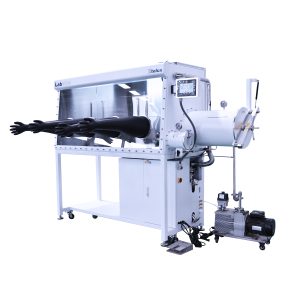
Advanced material research faces a universal challenge: many cutting-edge compounds degrade rapidly once exposed to ambient air. Trace oxygen and moisture trigger oxidation, hydrolysis and side reactions, ruining experimental samples and leading to inconsistent test data. An inert atmosphere glove box has become essential infrastructure for laboratories working with air-sensitive materials across energy, chemistry and semiconductor sectors.
What Is an Inert Atmosphere Glove Box?
A glove box is a hermetically sealed working chamber filled with high-purity nitrogen or argon. Operators manipulate samples via built-in butyl rubber gloves without breaking internal atmosphere. Equipped with antechamber (vacuum transition chamber), purification system and real-time O₂/H₂O sensors, premium vacuum glove boxes stably control oxygen and moisture levels below 1 ppm.
Without this controlled environment, lithium metal anodes, sulfide solid electrolytes, perovskite precursors and pyrophoric organometallic reagents cannot be safely handled.
Core Application Scenarios of Laboratory Glove Boxes
1. Lithium Battery & Solid-State Battery Assembly
This remains the largest market for laboratory glove boxes.
Coin cell, pouch cell and solid-state battery assembly must be completed inside inert environments. Lithium metal reacts violently with water vapor, while sulfide solid electrolytes release toxic hydrogen sulfide upon hydrolysis.
Researchers carry out electrode weighing, electrolyte filling, cell stacking and sealing inside glove boxes. Stable low water-oxygen atmosphere improves battery cycle life and guarantees repeatable electrochemical test results.
2. Perovskite Solar Cell Preparation
Perovskite photovoltaic materials are extremely sensitive to humidity and oxygen. Even short air exposure causes crystal degradation, reducing photoelectric conversion efficiency.
Many labs adopt stainless steel glove boxes for spin coating, thermal annealing and device encapsulation, forming a fully closed production workflow for perovskite thin-film solar cells.
3. Organometallic Chemistry & Catalyst Research
Grignard reagents, n-butyllithium, low-valent metal catalysts and other air-reactive chemicals require anhydrous and oxygen-free operating conditions.
Solvent purification systems can be integrated into glove box units to support continuous multi-step organic synthesis inside the sealed chamber.
4. Semiconductor, Quantum Dot & Nanomaterial Processing
Two-dimensional materials, quantum dots and semiconductor precursors easily form surface oxide layers under normal atmosphere. Glove box systems offer low-contamination environments for sample preparation, material transfer and thin-film deposition tests.
Vacuum Glove Box vs Standard Circulating Purification Glove Box
Many procurement engineers confuse these two mainstream types:
- Circulating purification glove box: Ideal for daily battery assembly, long-term stable operation, low daily gas consumption.
- Vacuum glove box: Equipped with powerful vacuum pumping antechamber, perfect for transferring large samples, degassing processes and projects requiring rapid atmosphere replacement.
Select your model according to sample size, transfer frequency and target atmosphere purity. Custom workstation size, dual-station structure, integrated heating oven and internal power outlets are available upon request.
Key Parameters to Check Before Buying a Glove Box
If you are sourcing laboratory glove boxes, focus on these specifications to avoid wrong purchases:
- Steady oxygen & water vapor index (≤1 ppm recommended for battery research)
- Chamber material: Acrylic for low-budget testing; 304 stainless steel for long-term heavy use
- Antechamber size: Match your largest sample or testing equipment
- Purification column regeneration cycle and maintenance cost
- Leak tightness: Lower leak rate means less inert gas consumption
- Optional accessories: gloves, vacuum valves, internal sockets, solvent traps, dew point sensors
Why Choose Customizable Glove Box Solutions from VacProduct
At VacProduct, we supply standard Lab series glove boxes and fully customized inert atmosphere systems for university labs, new energy R&D centers and chemical research institutes.
Our glove box systems support integration with coating machines, sealers, microscopes and vacuum equipment. We provide complete after-sales support including installation training, spare parts supply and remote technical troubleshooting.
Whether you need a single-station lab glove box for coin cell assembly or large dual-sided industrial glove boxes for pilot production, our engineering team can design atmosphere control solutions matching your workflow and budget.
Frequently Asked Questions
Q1: Can I use nitrogen instead of argon inside the glove box?
A: For most lithium battery experiments, high-purity nitrogen works well. Argon is preferred for lithium metal and highly reactive metal powder research.
Q2: How often should I regenerate the purification material?
A: Regeneration cycle depends on chamber tightness, operation frequency and incoming air volume. Under standard lab conditions, regular regeneration every 3–6 months is typical.
Q3: Can multiple instruments be placed inside one glove box?
A: Yes. We customize internal space layout and built-in power ports to accommodate stirrers, heating plates and small test devices.